
fake COD orders Pakistan
How to Reduce Fake COD Orders in Pakistan
15 September 2026 · 6 min read
Ask any Pakistani Shopify store that runs on cash-on-delivery what quietly eats their margin, and fake COD orders come up fast. A bogus order costs you the forward delivery charge, the return charge when it bounces back, and the staff time spent chasing a customer who was never going to pay. Because COD asks nothing of the buyer up front, it's the easiest kind of order to place and never honour.
You can't eliminate fake orders entirely, but you can cut them down a lot with a few checkout habits and by screening buyers before you ship. Here's the practical playbook.
What counts as a "fake" COD order?
- Orders placed with a wrong or unreachable phone number.
- Prank or competitor orders placed with no intention to receive.
- Duplicate orders from an indecisive buyer who only accepts one.
- Buyers who habitually refuse delivery at the door.
They all end the same way — a parcel that ships out, gets refused, and comes back as an RTO (return to origin), with you paying both legs.
1. Confirm the order before you ship
The single most effective filter. A quick confirmation weeds out impulse taps and wrong numbers before you spend a rupee on shipping.
- OTP or WhatsApp confirmation: ask the buyer to confirm the order via a code or a one-tap WhatsApp reply. A number that can't receive the message is a red flag.
- Call high-value orders: a 30-second call to confirm a large COD order is cheaper than a two-way return.
2. Validate the phone number at checkout
Make the phone field required and validate its format (a correct Pakistani mobile number). Reject obviously junk entries. Most fake orders start with a bad number, so this alone removes a chunk of them.
3. Screen repeat offenders before you ship again
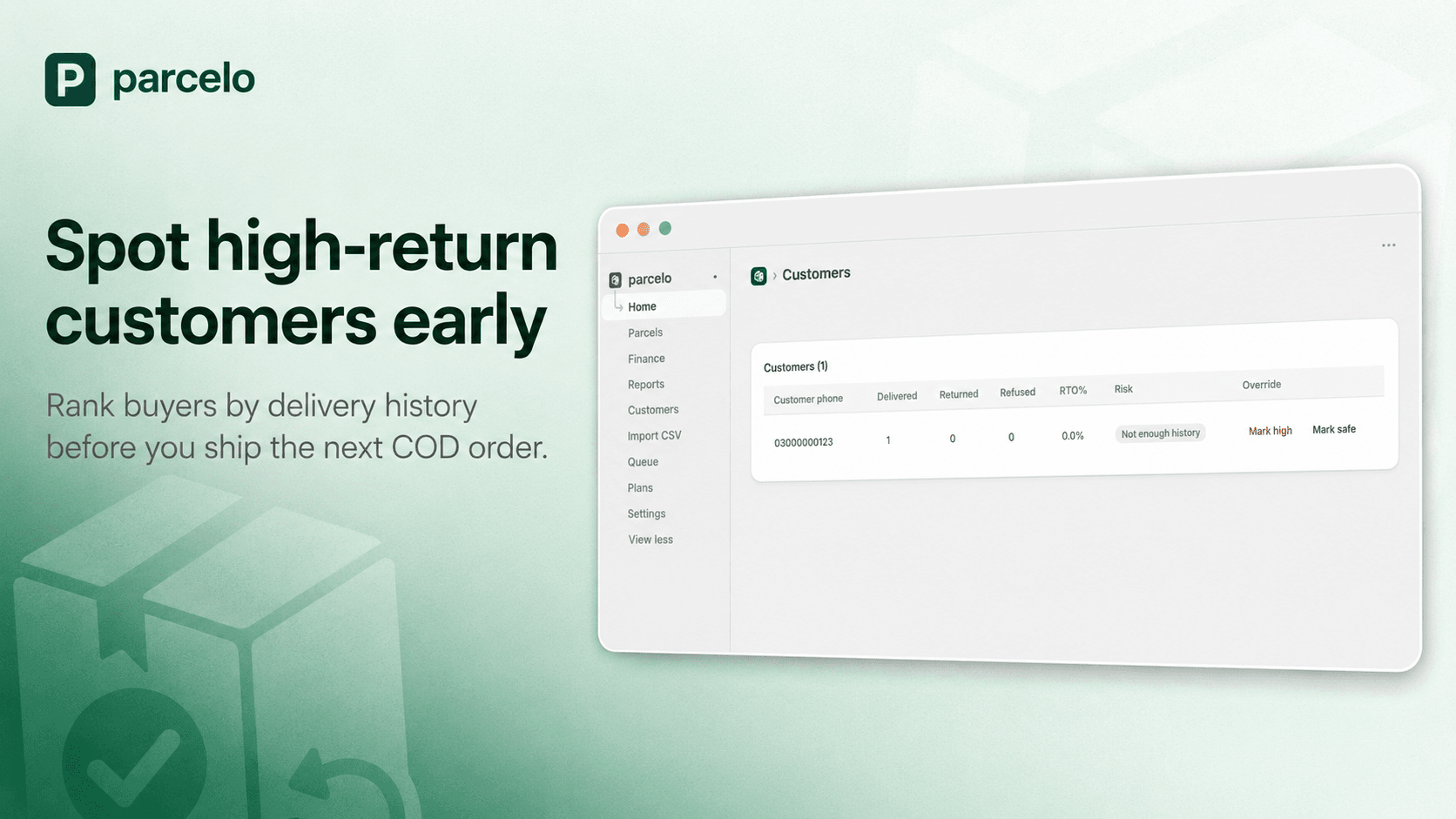
The buyers who cost you the most are the ones who refuse delivery again and again. If you don't track it, you keep shipping to them. The fix is a per-customer delivery history — delivered, returned, refused — so risky buyers stand out before the next COD order goes out.
This is exactly what Parcelo's customer return-risk screen does: it ranks buyers by their history and RTO rate. On the Pro plan, a new order from a high-risk customer is tagged automatically, so it stands out in your order list and you can confirm it before shipping.
4. Nudge risky orders toward advance payment
You don't have to refuse a risky order outright — shift the risk. Offer a small discount for prepaid orders, or ask for a partial advance on high-value items. Buyers placing fake orders rarely pay anything up front, so this quietly filters them out while keeping genuine sales.
5. Watch for risk signals
Patterns worth flagging for a manual check before dispatch:
- Multiple orders to the same address under different names.
- Mismatched or incomplete addresses.
- Disposable or clearly invalid phone numbers.
- A first-time buyer placing an unusually large COD order.
6. Use your own data
Fake-order patterns show up in the numbers — certain customers, areas, or couriers produce more returns. When you reconcile COD properly and track return rate over time, you can tighten confirmation on the segments that bounce most and leave your reliable buyers alone. Parcelo follows every parcel, reconciles delivered vs. returned, and surfaces return rate per customer and per courier so these patterns are obvious.
The bottom line
Fake COD orders are a workflow problem you can control: confirm orders, validate phone numbers, screen repeat offenders, nudge risky buyers to prepay, and act on your own return data. Parcelo gives you the customer history and reconciliation to do the screening automatically — so you ship to buyers who actually pay. Explore what Parcelo does or start a 7-day free trial.